

Thank you for Subscribing to Retail Business Review Weekly Brief


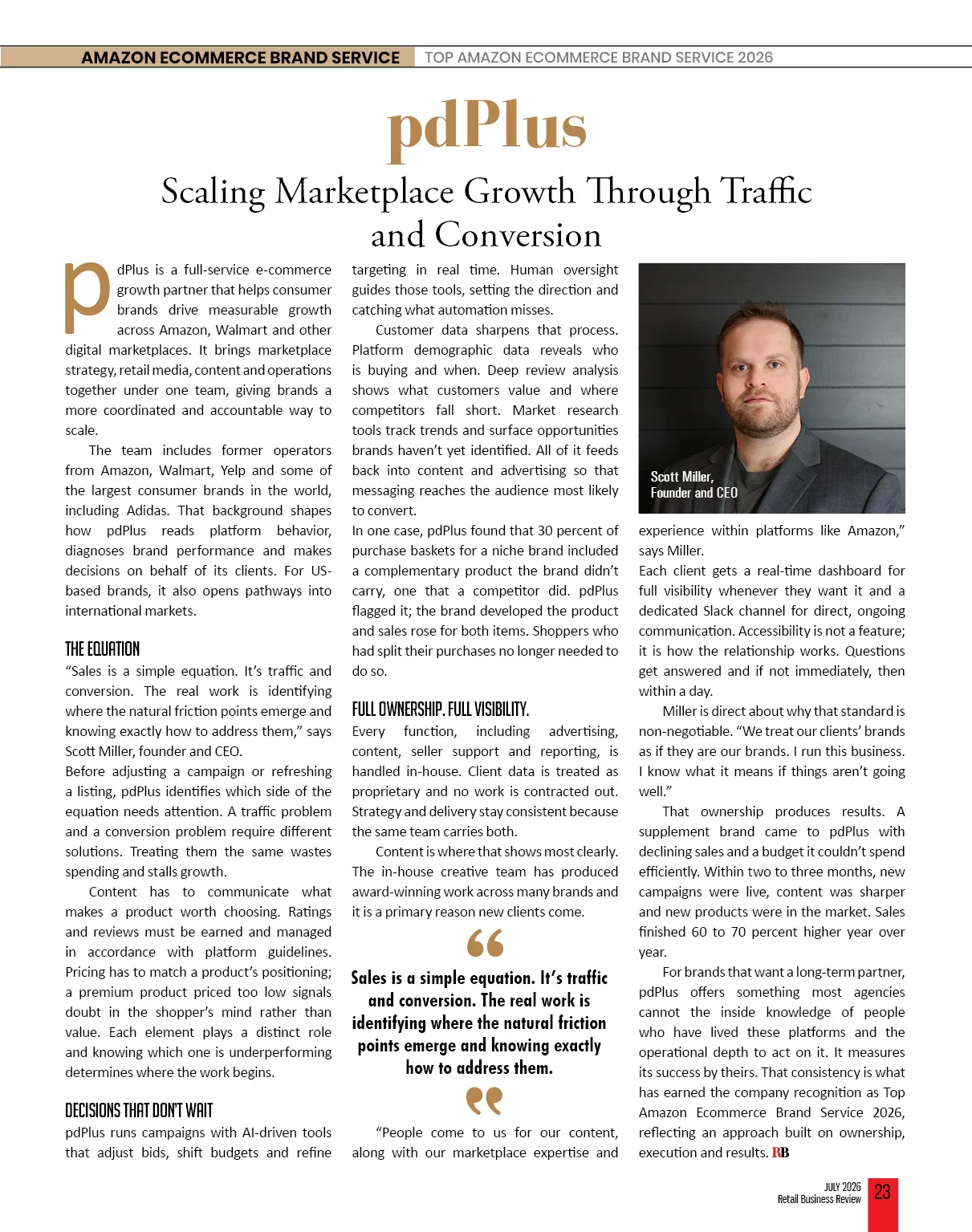
 Scott Miller, Founder and CEO
What challenges do consumer brands face when scaling across digital marketplace platforms today?
pdPlus is a full-service e-commerce growth partner that helps consumer brands drive measurable growth across Amazon, Walmart and other digital marketplaces. It brings marketplace strategy, retail media, content and operations together under one team, giving brands a more coordinated and accountable way to scale.
The team includes former operators from Amazon, Walmart, Yelp and some of the largest consumer brands in the world, including Adidas. That background shapes how pdPlus reads platform behavior, diagnoses brand performance and makes decisions on behalf of its clients. For US-based brands, it also opens pathways into international markets.
The Equation
How does pdPlus evaluate traffic and conversion issues within marketplace growth performance strategies?
“Sales is a simple equation. It’s traffic and conversion. The real work is identifying where the natural friction points emerge and knowing exactly how to address them,” says Scott Miller, founder and CEO.
Before adjusting a campaign or refreshing a listing, pdPlus identifies which side of the equation needs attention. A traffic problem and a conversion problem require different solutions. Treating them the same wastes spending and stalls growth.
Content has to communicate what makes a product worth choosing. Ratings and reviews must be earned and managed in accordance with platform guidelines. Pricing has to match a product’s positioning; a premium product priced too low signals doubt in the shopper’s mind rather than value. Each element plays a distinct role and knowing which one is underperforming determines where the work begins.
Decisions That Don’t Wait
Why is real-time campaign optimization important for improving marketplace advertising and customer engagement today?
pdPlus runs campaigns with AI-driven tools that adjust bids, shift budgets and refine targeting in real time. Human oversight guides those tools, setting the direction and catching what automation misses.
-
Sales is a simple equation. It’s traffic and conversion. The real work is identifying where the natural friction points emerge and knowing exactly how to address them.
Customer data sharpens that process. Platform demographic data reveals who is buying and when. Deep review analysis shows what customers value and where competitors fall short. Market research tools track trends and surface opportunities brands haven’t yet identified. All of it feeds back into content and advertising so that messaging reaches the audience most likely to convert.
In one case, pdPlus found that 30 percent of purchase baskets for a niche brand included a complementary product the brand didn’t carry, one that a competitor did. pdPlus flagged it; the brand developed the product and sales rose for both items. Shoppers who had split their purchases no longer needed to do so.
Full Ownership. Full Visibility.
In what way does in-house execution improve visibility and accountability for marketplace brands?
Every function, including advertising, content, seller support and reporting, is handled in-house. Client data is treated as proprietary and no work is contracted out. Strategy and delivery stay consistent because the same team carries both.
Content is where that shows most clearly. The in-house creative team has produced award-winning work across many brands and it is a primary reason new clients come.
“People come to us for our content, along with our marketplace expertise and experience within platforms like Amazon,” says Miller.
Each client gets a real-time dashboard for full visibility whenever they want it and a dedicated Slack channel for direct, ongoing communication. Accessibility is not a feature; it is how the relationship works. Questions get answered and if not immediately, then within a day.
Miller is direct about why that standard is non-negotiable. “We treat our clients’ brands as if they are our brands. I run this business. I know what it means if things aren’t going well.”
That ownership produces results. A supplement brand came to pdPlus with declining sales and a budget it couldn’t spend efficiently. Within two to three months, new campaigns were live, content was sharper and new products were in the market. Sales finished 60 to 70 percent higher year over year.
For brands that want a long-term partner, pdPlus offers something most agencies cannot the inside knowledge of people who have lived these platforms and the operational depth to act on it. It measures its success by theirs. That consistency is what has earned the company recognition as Top Amazon Ecommerce Brand Service 2026, reflecting an approach built on ownership, execution and results.
Choosing the Right Amazon E-commerce Brand Service Partner
Amazon’s marketplace has shifted from a visibility-driven environment to one defined by purchase behavior, forcing brand leaders to rethink how growth is created and sustained. Clicks and impressions no longer serve as reliable proxies for performance when conversion dynamics, customer intent and competitive positioning determine whether traffic translates into revenue. Many service providers still anchor their approach in backward-looking reporting, leaving brands reactive rather than decisive in a marketplace where pricing pressure, content quality and review signals evolve continuously.
Effective brand management on Amazon begins with a clear understanding of where friction exists between traffic generation and conversion. Traffic alone does not guarantee growth if product messaging fails to communicate differentiation or if pricing signals create doubt about value. Conversion, in turn, depends on how well content aligns with shopper expectations, how reviews reinforce credibility and how pricing reflects both positioning and perceived quality. The interplay between these factors requires constant recalibration rather than static optimization, particularly as external factors such as advertising costs and competitor behavior shift daily.
Another defining challenge lies in interpreting fragmented customer signals across channels. Buyers no longer follow linear paths and their decisions are shaped by interactions that span marketplaces, search platforms and external media. A service partner must therefore move beyond isolated platform management and instead connect insights across these environments. Brands benefit when messaging, targeting and campaign investment are informed by a unified view of customer behavior rather than siloed metrics that obscure true demand patterns.
Decision-making speed has become equally critical. Retrospective analysis offers limited value when advertising auctions, search rankings and consumer sentiment change in real time. The ability to continuously test, learn and adjust campaigns determines whether brands can capture incremental demand or lose ground to more adaptive competitors. This requires not only advanced tooling but also disciplined interpretation of data, ensuring that automation is guided by strategic intent rather than left unchecked.
Equally important is the depth of engagement between the service provider and the brand. Marketplace performance rarely improves with surface-level adjustments alone. It demands an understanding of product, customer and competitive landscape that mirrors internal ownership. Communication transparency, accessibility of performance data and responsiveness to emerging issues shape how effectively a provider can function as an extension of the brand’s team rather than a detached vendor.
Within this context, pdPlus presents a model aligned with these evolving demands. Its foundation in operator experience, drawn from backgrounds within major retailers, marketplaces and global brands, informs a practical understanding of marketplace dynamics rather than a purely theoretical approach. It integrates traffic and conversion management by addressing content quality, pricing logic and review strategy in tandem, rather than isolating them as separate functions. Its use of AI-supported advertising tools and partner platforms enables real-time budget allocation and targeting decisions, reducing reliance on delayed reporting. The firm’s ability to extract insight from customer reviews, basket data and demographic data supports more precise messaging, product positioning and even new product identification. Its full-service, in-house model ensures consistency across content, advertising and account management. At the same time, continuous client access through dashboards and direct communication channels reinforces transparency and responsiveness, positioning it as a partner capable of driving sustained marketplace performance.
...Read more
Amazon Ecommerce Brand Services Info
Q1
What Should Brands Expect from Amazon Ecommerce Brand Services?
Amazon Ecommerce Brand Services work best when marketplace strategy, retail media, content, analytics and account support all connect instead of running as separate projects. For brands selling on Amazon, performance usually comes down to how traffic, listings, reviews, pricing and advertising spend work together. A strong service partner understands that even a small change to a product page can affect conversion rates, ad efficiency and overall account performance over time.
Q2
How Does pdPlus Support Marketplace Growth?
pdPlus approaches Amazon Ecommerce Brand Services through a broader marketplace model that also includes Walmart and other digital platforms. Its team includes former operators from Amazon, Walmart, Yelp and major consumer brands, giving it direct insight into how marketplaces behave and where performance gaps typically begin. That operational background helps brands make decisions based on platform mechanics instead of generic campaign advice while also creating a more practical path for expansion beyond domestic channels.
Q3
Which Capabilities Matter Most in Amazon Brand Management?
Content quality, advertising discipline, review monitoring, pricing strategy and reporting consistency often carry the most weight. Amazon Ecommerce Brand Services should help brands understand whether weak performance comes from low traffic, poor conversion or a disconnect between product positioning and shopper expectations. Treating every sales decline as an advertising problem can waste budget while leaving listing issues unresolved. Strong product pages, compliant reviews and consistent pricing often determine whether media spend actually converts into revenue.
Q4
Why Do Real-Time Advertising Decisions Matter?
Amazon advertising moves quickly, so delayed reporting can leave brands spending against weak keywords or outdated targets. Amazon Ecommerce Brand Services need both the tools and judgment to adjust bids, budgets and targeting while campaigns are still active. pdPlus combines AI-driven campaign management with human oversight, using customer data, platform behavior and market research to react to shopper trends before performance issues become more obvious in monthly reports.
Q5
How Can In-House Execution Improve Brand Visibility?
Keeping advertising, content, seller support and reporting in-house can reduce delays and create clearer accountability. Amazon Ecommerce Brand Services often depend on fast action when campaigns, listings or account issues change unexpectedly. pdPlus supports this with live dashboards, dedicated Slack channels and an internal creative team that manages content production directly. For brands, that setup makes it easier to understand what changed, who handled it and how those decisions affected sales performance.
Q6
What Should Buyers Evaluate Before Choosing a Service Partner?
Buyers should look beyond broad promises and focus on how a partner measures sales quality rather than just advertising activity. Effective Amazon Ecommerce Brand Services connect ROAS, contribution margin, market share, content performance and review signals into a clearer picture of marketplace health. pdPlus says it tracks revenue, ROAS, market share and contribution margin, while also offering marketplace management, paid media, creative execution and data analytics as core services. The right partner should provide clear reporting, disciplined testing and enough marketplace experience to protect margins while building demand.
