

Thank you for Subscribing to Retail Business Review Weekly Brief


 Andrew Zetterholm, Owner
What limitations exist when AI tools operate only at isolated functional levels?
AI tools today help growing brands manage their products on Amazon through faster ad optimization, graphics and copy, but often only at a single-function level. However, they operate in isolation and frequently cannot connect pricing, inventory and operational decisions into a cohesive growth strategy.
MegaRhino bridges this gap by combining AI-driven analysis, applied across advertising, pricing, inventory and operations, with experienced human judgment.
“We use AI to surface the right insights—but real growth comes from connecting those insights across the entire business,” says Andrew Zetterholm, owner.
Rather than operating as a traditional management agency, MegaRhino serves as a growth partner focused on connecting platform decisions with broader e-commerce goals, supply chain and retail strategy.
“We support brands by aligning positioning, pricing and marketing strategy, enabling them to meet real customer needs and scale more efficiently and profitably,” says Zetterholm.
Drawing on over 25 years of experience running small businesses, Zetterholm brings an operator’s perspective on how Amazon integrates into their broader operations.
MegaRhino’s approach is supported by a team with nearly a century of combined Amazon experience. Growing alongside the platform over the past decade, they have developed a deep understanding of what drives performance across the platform.
Rather than operating in silos, the team evaluates how pricing, inventory, fulfillment and marketing decisions connect and influence each other. They ensure that products are positioned to meet genuine consumer needs, making marketing more effective from the outset. By refining positioning and pricing, the focus shifts from forcing demand to reaching the right audience.
Eliminating Cost Leaks and Driving Performance
How do reimbursement gaps and advertising inefficiencies impact overall marketplace profitability for brands?
One of the most critical and often overlooked areas of cost leaks is reimbursement for damaged or lost inventory within Amazon’s warehouses. Disconnects between the platform’s financial and warehouse systems can result in brands not being fully credited. MegaRhino addresses this through a combination of AI-supported auditing and human oversight, often securing thousands of dollars per month for clients.
Advertising inefficiency is another significant source of profit leakage. Many brands lose substantial revenue by managing campaigns manually or relying on limited algorithmic tools. Through automation tools like hourly bidding adjustments, enhanced by AI-driven insights and strategic oversight, they reduce wasted spend and improve campaign efficiency well beyond manual oversight.
-
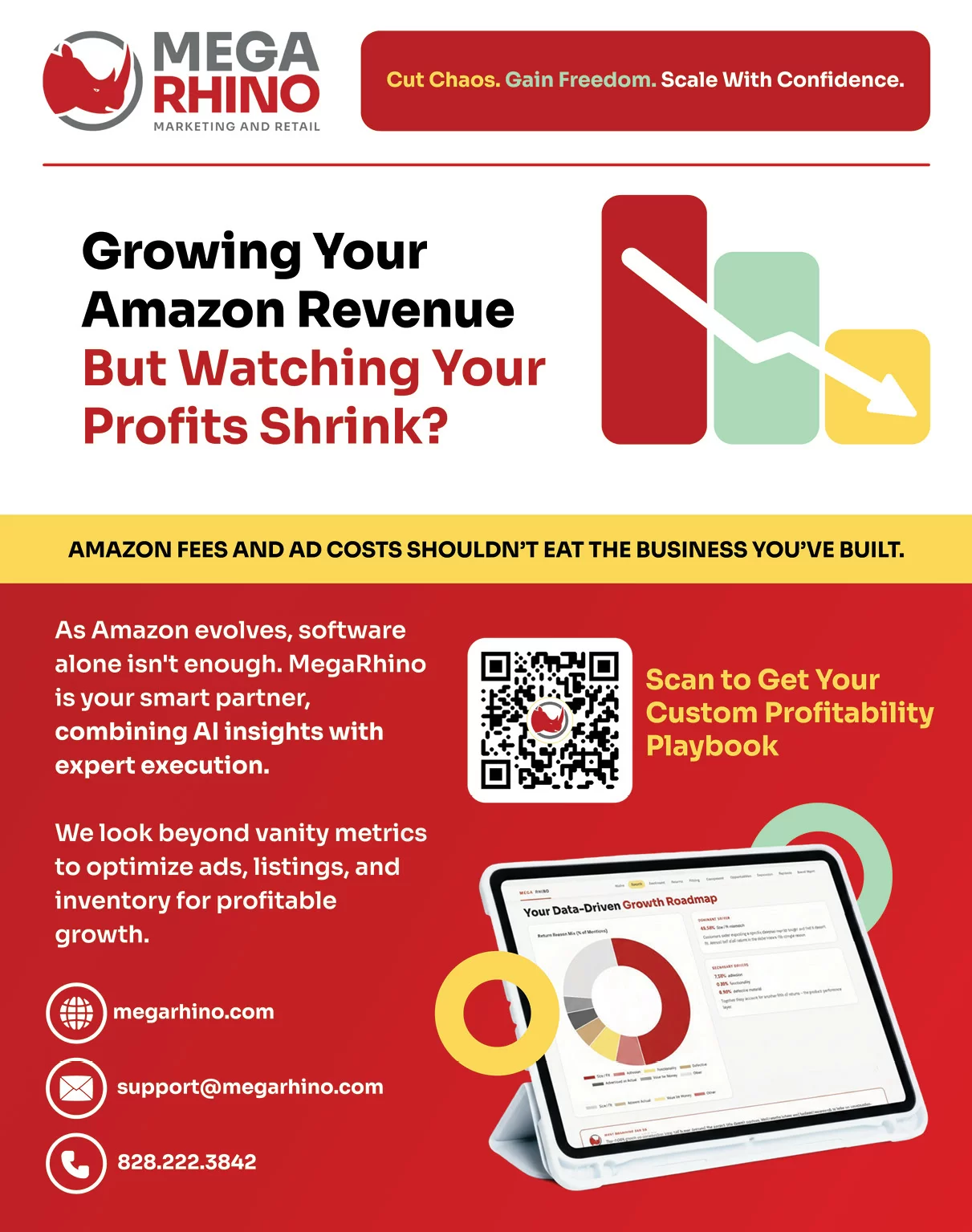
We support brands by aligning positioning, pricing and marketing strategy, enabling them to meet real customer needs and scale more efficiently and profitably.
By analyzing the entire customer journey, from initial impressions to clicks and purchase, they refine key listing elements like images, titles and pricing. Improved conversion rates enhance visibility within Amazon’s algorithm, creating a flywheel effect that drives higher sales and strengthens rankings. When combined with optimized advertising, this approach accelerates profitable growth.
Building Growth through Operational Discipline
Why is aligning inventory, logistics, and pricing essential for sustainable e-commerce growth?
MegaRhino places equal emphasis on ensuring that revenue growth translates into profitability through disciplined, data-driven execution. The team uses a proprietary AI-driven system to evaluate multiple shipping scenarios, navigate Amazon’s complex inbound requirements and manage inventory levels to maintain availability while minimizing excess stock.
In what way can restructuring listings and operations improve long-term marketplace performance outcomes?
In one instance, MegaRhino worked with a pet brand whose Amazon presence was fragmented across multiple listings and third-party sellers. They consolidated listings, established brand controls and restructured the catalog to improve visibility and conversion. The team also supported inventory planning, cash flow management and transitioned operations to a third-party warehouse to streamline fulfillment across channels.
Within the first year, the founders were able to sustain themselves solely on the business’s income, and over four years, the brand’s performance grew tenfold.
As marketplace complexity increases, MegaRhino enables brands to move from isolated optimizations to connected, business-level decisions. As Amazon continues to evolve, success increasingly depends on how well brands connect decisions across the entire business—not just the platform. For many brands, the next phase of growth won't come from doing more—but from aligning what's already being done. For brands navigating the growing complexity of Amazon, a more connected, business-first approach may be the difference between growth and profitability.
Rethinking Amazon Brand Management for Sustainable Growth
Amazon has matured into a complex commercial environment where growth is no longer dictated by visibility alone but by the precision of decisions made across interconnected systems. Many brands enter the marketplace with strong products yet encounter fragmented performance as advertising, inventory, pricing and listing optimization operate in silos. The challenge is not access to tools or data, but the ability to interpret large volumes of information and translate it into coordinated action that improves both revenue and profitability.
Technology has accelerated the pace at which brands can collect and process marketplace data. Automated tools can adjust bids, surface keyword trends and identify anomalies faster than any manual workflow. Yet the limitation becomes clear when these outputs require prioritization. Growth on Amazon is shaped by trade-offs—between inventory depth and storage costs, between aggressive bidding and margin erosion, between conversion gains and long-term brand positioning. Systems can present options, but the responsibility of choosing the right path rests on informed human judgment that connects tactical signals to broader business objectives.
A disciplined approach to Amazon brand services reflects this balance. Effective partners do not treat the marketplace as an isolated sales channel but as an extension of a company’s wider commercial model. Decisions around fulfillment, supply chain structure and channel alignment influence not only marketplace performance but overall business efficiency. Brands that succeed tend to integrate Amazon into their broader e-commerce and retail strategy, ensuring that operational decisions reinforce one another rather than compete for resources.
Attention to profitability is another defining factor. Revenue expansion alone often masks inefficiencies that accumulate over time. Hidden losses frequently emerge in areas that receive limited scrutiny, such as unclaimed reimbursements for damaged or lost inventory within fulfillment networks. Advertising inefficiencies also persist when campaigns are managed intermittently or without continuous optimization. Even at the product level, underperforming listings or weak conversion pathways can dilute the impact of traffic generation. Sustained improvement depends on identifying these leak points and addressing them consistently rather than episodically.
The mechanics of conversion play an equally important role. Growth follows a sequence that begins with visibility, advances through engagement and culminates in purchase. Each stage requires refinement. Search presence must align with relevant demand signals, product pages must clearly communicate value, and pricing must reflect both competitive context and margin requirements. When these elements work in unison, incremental improvements compound, increasing organic reach and reinforcing advertising performance. The result is a reinforcing cycle where better conversion drives higher visibility, which in turn fuels further growth.
MegaRhino positions itself within this framework by emphasizing decision-making that extends beyond isolated marketplace tactics. It integrates data-driven analysis with hands-on oversight, using automation to accelerate insight while maintaining human control over strategic direction. Its approach connects Amazon performance to broader business considerations, including supply chain configuration, inventory planning and channel coordination.
The firm also places clear weight on profitability, incorporating fund recovery, cost optimization and inventory balance into its core service rather than treating them as secondary activities. By aligning tactical execution with long-term business outcomes, it offers a structured path for brands aiming to convert marketplace presence into sustained, measurable growth.
...Read more
Amazon Brand Services Info
Q1
What Do Amazon Brand Services Include for Growing Marketplace Brands?
Amazon Brand Services typically bring together listing optimization, marketplace advertising, brand management, catalog oversight, performance tracking and operational support. The category matters because Amazon growth is shaped by many connected decisions, from product visibility and conversion content to stock discipline and margin control. A strong service model helps brands avoid treating ads, inventory and listings as separate tasks, instead linking daily execution to sustainable marketplace performance. It also gives decision-makers a clearer view of which actions protect revenue, strengthen customer trust and support repeatable growth.
Q2
How Does MegaRhino Support Amazon Brand Services?
MegaRhino applies Amazon Brand Services as a structured growth discipline rather than a narrow marketing function. The company is positioned as a strategic growth partner for brands that need profitable Amazon scale. Its work places clear emphasis on fund recovery, cost optimization and inventory balance, showing how marketplace management can address both front-end growth and back-end financial leakage. This makes the service model practical for brands seeking measurable, durable progress.
Q3
Why Is Profitability Central to Amazon Marketplace Growth?
Traffic and sales gains can lose value when rising ad spend, excess inventory, unresolved account issues or missed reimbursements reduce margin. Amazon Brand Services help connect growth activity with financial discipline by aligning visibility, conversion and operations. The practical goal is not only to increase marketplace presence but to make that presence healthier, more predictable and easier to manage over time. Profitability also helps teams decide when to push campaigns, adjust catalog strategy or protect working capital.
Q4
What Should Brands Look for in an Amazon Brand Services Partner?
A useful partner should understand both marketplace mechanics and business outcomes. That means helping with listing performance, advertising decisions, inventory constraints, account processes, cost controls and reporting clarity. Amazon Brand Services should also translate data into priorities rather than simply producing activity. Brands benefit when recommendations show how each action supports discoverability, profitability, operational stability and long-term positioning. The right fit should be able to explain trade-offs in plain business terms, especially when growth, margin and inventory goals compete.
Q5
How Can Amazon Brand Management Reduce Operational Friction?
Amazon selling creates friction through changing policies, catalog issues, advertising complexity, inventory pressure and the need for consistent brand presentation. Amazon Brand Services reduce that burden by creating a coordinated process for day-to-day management. Better coordination helps brands see where delays, costs or missed opportunities are forming, then address them before they interrupt conversion, replenishment or customer trust. This kind of operating rhythm is especially useful when teams need faster decisions without losing control of brand standards.
Q6
What Makes MegaRhino Relevant to Marketplace-Focused Brands?
MegaRhino is relevant because its approach connects tactical execution with longer-term business outcomes. The company supports brands aiming to turn marketplace presence into sustained, measurable growth, while its recognition in Amazon Brand Services reflects work across profitability, operations and brand performance. Rather than presenting Amazon as a single sales channel, the profile frames the company’s role around disciplined scaling, practical optimization and ongoing marketplace control.
