

Thank you for Subscribing to Retail Business Review Weekly Brief


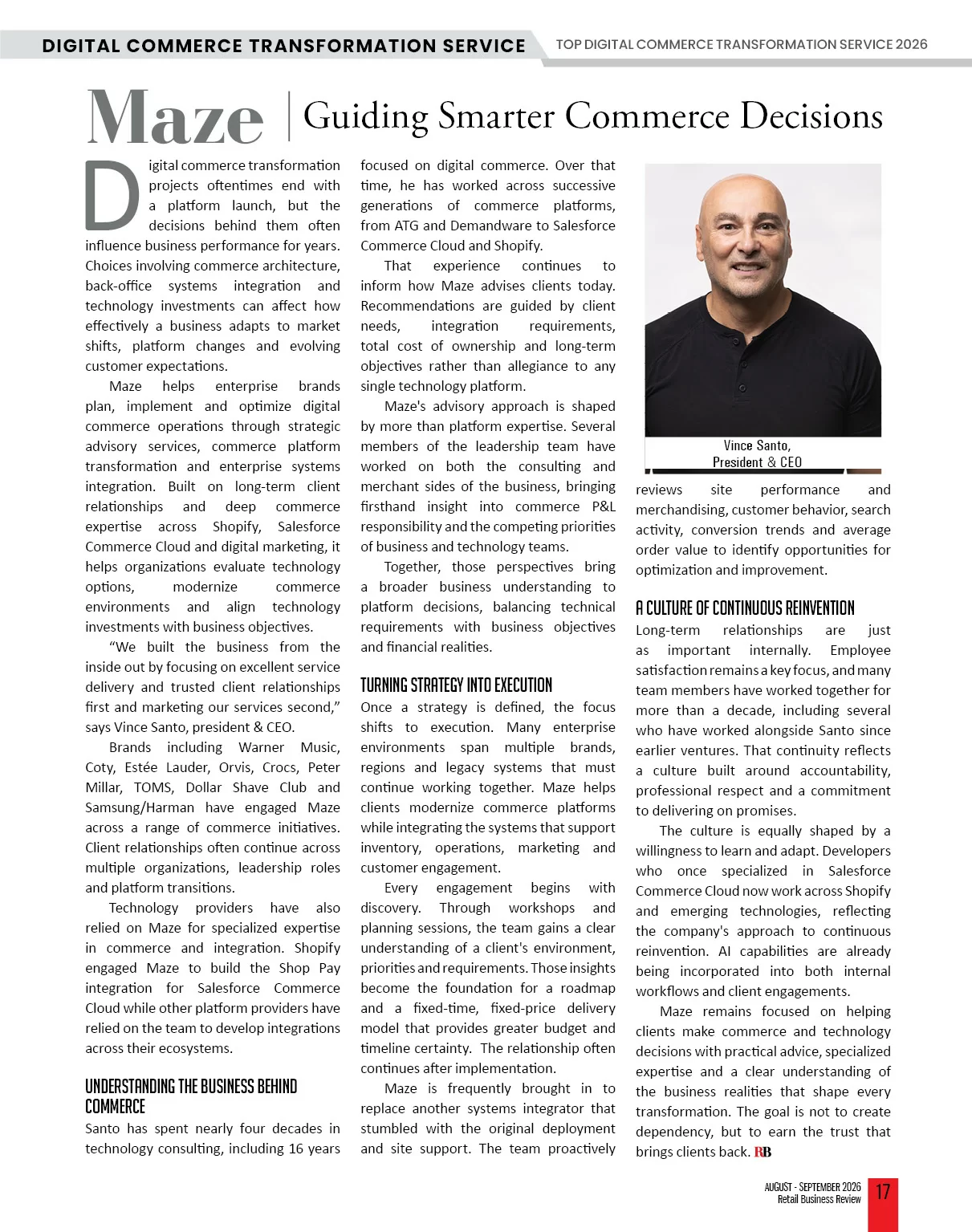
 Vince Santo, President & CEO
Digital commerce transformation projects oftentimes end with a platform launch, but the decisions behind them often influence business performance for years. Choices involving commerce architecture, back-office systems integration and technology investments can affect how effectively a business adapts to market shifts, platform changes and evolving customer expectations.
Maze helps enterprise brands plan, implement and optimize digital commerce operations through strategic advisory services, commerce platform transformation and enterprise systems integration. Built on long-term client relationships and deep commerce expertise across Shopify, Salesforce Commerce Cloud and digital marketing, it helps organizations evaluate technology options, modernize commerce environments and align technology investments with business objectives.
“We built the business from the inside out by focusing on excellent service delivery and trusted client relationships first and marketing our services second,” says Vince Santo, president & CEO.
Brands including Warner Music, Coty, Estée Lauder, Orvis, Crocs, Peter Millar, TOMS, Dollar Shave Club and Samsung/Harman have engaged Maze across a range of commerce initiatives. Client relationships often continue across multiple organizations, leadership roles and platform transitions.
Technology providers have also relied on Maze for specialized expertise in commerce and integration. Shopify engaged Maze to build the Shop Pay integration for Salesforce Commerce Cloud while other platform providers have relied on the team to develop integrations across their ecosystems.
Understanding the Business Behind Commerce
Santo has spent nearly four decades in technology consulting, including 16 years focused on digital commerce. Over that time, he has worked across successive generations of commerce platforms, from ATG and Demandware to Salesforce Commerce Cloud and Shopify.
That experience continues to inform how Maze advises clients today. Recommendations are guided by client needs, integration requirements, total cost of ownership and long-term objectives rather than allegiance to any single technology platform.
-
We built the business from the inside out by focusing on delivery first and growth second.
Maze's advisory approach is shaped by more than platform expertise. Several members of the leadership team have worked on both the consulting and merchant sides of the business, bringing firsthand insight into commerce P&L responsibility and the competing priorities of business and technology teams.
Together, those perspectives bring a broader business understanding to platform decisions, balancing technical requirements with business objectives and financial realities.
Turning Strategy into Execution
Once a strategy is defined, the focus shifts to execution. Many enterprise environments span multiple brands, regions and legacy systems that must continue working together. Maze helps clients modernize commerce platforms while integrating the systems that support inventory, operations, marketing and customer engagement.
Every engagement begins with discovery. Through workshops and planning sessions, the team gains a clear understanding of a client's environment, priorities and requirements. Those insights become the foundation for a roadmap and a fixed-time, fixed-price delivery model that provides greater budget and timeline certainty. The relationship often continues after implementation.
Maze is frequently brought in to replace another systems integrator that stumbled with the original deployment and site support. The team proactively reviews site performance and merchandising, customer behavior, search activity, conversion trends and average order value to identify opportunities for optimization and improvement.
A Culture of Continuous Reinvention
Long-term relationships are just as important internally. Employee satisfaction remains a key focus, and many team members have worked together for more than a decade, including several who have worked alongside Santo since earlier ventures. That continuity reflects a culture built around accountability, professional respect and a commitment to delivering on promises.
The culture is equally shaped by a willingness to learn and adapt. Developers who once specialized in Salesforce Commerce Cloud now work across Shopify and emerging technologies, reflecting the company's approach to continuous reinvention. AI capabilities are already being incorporated into both internal workflows and client engagements.
Maze remains focused on helping clients make commerce and technology decisions with practical advice, specialized expertise and a clear understanding of the business realities that shape every transformation. The goal is not to create dependency, but to earn the trust that brings clients back.
Choosing a Digital Commerce Transformation Partner for Sustainable Growth
Digital commerce transformation has become less about launching a new storefront and more about building a connected business environment that can adapt to changing customer expectations, platform evolution and increasingly complex technology ecosystems. Executive teams evaluating transformation partners face a difficult challenge: balancing growth ambitions against platform decisions, integration requirements and the need to generate measurable returns without creating long-term dependency on external consultants.
The most successful transformation engagements start with a vision of what a company wants to achieve rather than its technology preferences. While commerce platforms develop quickly, choosing a certain platform does not define success. Multibrand, multinational or multisegment companies often find that the biggest challenge in commerce transformation is connecting commerce experiences with marketing tools, customer data platforms, enterprise resource planning solutions and legacy back office systems. A transformation partner must therefore demonstrate an ability to align technology decisions with commercial goals while accounting for the realities of an existing environment.
Experience across both modern commerce platforms and enterprise integration environments has become increasingly important. Many consulting firms can implement front-end commerce experiences, but fewer possess deep knowledge of how those experiences interact with complex business systems. Buyers should look for evidence that a provider can navigate platform transitions, evaluate the total cost of ownership and create practical migration roadmaps that support future growth rather than simply replacing one technology stack with another.
It is also important that a partner be able to give some strategic advice after the process of implementation begins. Commerce leaders are constantly challenged by the necessity to boost conversion rates, customer engagement, revenue performance, adjust to changes in consumer behavior and embrace emerging technologies. A partner that contributes ongoing insight, performance analysis and informed recommendations often creates greater business impact than one focused exclusively on project execution. The combination of technical and commercial expertise allows transformation initiatives to evolve according to the changing business priorities instead of remaining a mere technological project.
Trust remains another defining factor in successful engagements. Large-scale commerce initiatives involve significant investment, organizational change and cross-functional coordination. The predictable model of delivery, clear communication and accountability of the results help to minimize risks for the executive sponsor. Fixed-scope transformation programs can be especially helpful when they are preceded by a thorough discovery process, setting the right expectations and timelines before the beginning of implementation.
Maze stands out as a compelling choice for organizations pursuing digital commerce transformation because its approach aligns closely with these priorities. The firm combines deep expertise across Shopify and Salesforce Commerce Cloud with extensive experience integrating commerce platforms into complex enterprise environments. Its leadership and consulting teams bring perspectives from both advisory and merchant-side roles, enabling it to understand commercial realities alongside technical requirements.
Maze emphasizes structured discovery, fixed-price delivery and long-term client relationships built on trust and accountability rather than dependency. Its proactive focus on performance improvement, platform strategy and future technology shifts positions it as a strong partner for organizations looking to modernize commerce capabilities while maintaining a clear path toward sustainable growth.
...Read more
Digital Commerce Transformation Services Info
Q1
What Should Retailers Expect From Digital Commerce Transformation Services?
Digital Commerce Transformation Services should connect strategy, platform choice, implementation and growth planning around the way customers actually shop. The work usually reaches beyond a storefront rebuild. It can cover commerce architecture, marketing technology, merchandising control, data flow and the handoff between brand teams and technical teams. Done well, it gives leaders a clearer way to decide what to keep, what to replace and what must change first.
Q2
How Does Maze Help Brands Get Unstuck?
Platform complexity can slow even strong retail brands. Maze works with complex, large and enterprise brands that need clearer commerce decisions, then helps identify the right platform and execute with long-term growth in mind. Its work spans Shopify, Salesforce Commerce Cloud and Klaviyo, with attention to technical debt, licensing costs, migration paralysis and vendor confusion. In that setting, Digital Commerce Transformation Services become a practical route out of stalled roadmaps rather than another technology exercise. The goal is not change for its own sake, but usable commercial movement.
Q3
Why Do Platform Decisions Matter So Much in Commerce Modernization?
A poor platform decision can leave merchandisers waiting on development queues, marketers working around rigid tools and leaders paying for systems that no longer fit the business. Digital Commerce Transformation Services should test how a platform handles catalog updates, customer journeys, integrations, personalization and future change before a brand commits. The best decisions are not only about software names. They are about how quickly teams can adapt without breaking the customer experience or creating another costly migration.
Q4
What Problems Do Commerce Teams Usually Need to Fix First?
Most teams already know where the pain is. Slow feature releases, aging architecture, unclear return on technology spend and dependence on disconnected systems often appear before a full rebuild is discussed. Digital Commerce Transformation Services help turn those frustrations into a roadmap, so teams can sort urgent fixes from deeper architecture choices. That prevents a brand from treating every symptom as a new project or every platform promise as a solution.
Q5
How Should Leaders Evaluate a Digital Commerce Partner?
Leaders should bring real examples into the review: a stalled migration plan, a costly license renewal, a personalization gap or a checkout issue that keeps returning. Digital Commerce Transformation Services are easier to judge when the partner can explain tradeoffs in plain terms and show how the work will affect marketing, merchandising and IT. A useful partner should make the path clearer, not bury the team in more tools, dashboards or jargon.
Q6
What Makes Commerce Transformation Valuable After Launch?
Launch is only one checkpoint. Digital Commerce Transformation Services create value when the new environment keeps supporting faster updates, cleaner integrations and better control for the teams running the business every day. A brand should be able to add features, adjust campaigns and support growth without rebuilding the same workaround again. The real test comes months later, when the platform still feels manageable and the team can move without waiting on the same bottlenecks.
