

Thank you for Subscribing to Retail Business Review Weekly Brief

Vision Express
Maximo Daniel Pisa, Head of Planning & Retail Analytics
Labour Planning Comes Onstage

Maximo Daniel Pisa
Undoubtedly, the recent pandemic has configured a new world for all of us and the retail industry isn’t an exception. After going through a series of lockdowns, the current context still represents a big challenge for this sector in many senses. One of them, perhaps the most important for operations management, is labour.
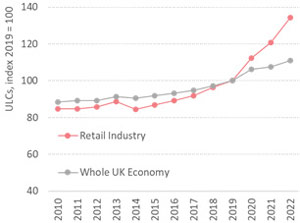 Chart 1: Labour Cost in the Retail Industry
Cost of labour input (ULC) per unit of output, inflation-adjusted.
Source: Office for National Statistics.
In fact, staffing costs have increased sensibly in the recent years relative to both pre-covid levels and the whole UK economy (see chart 1). This is mainly due to a combination of low real gross value added (GVA) and high growth in employment costs, especially fuelled by the rise in national living wage and compensation of employees (including social contributions). Indeed, according to the Low Pay Commission, 45% of all minimum wage jobs last year were in just 3 occupation groups: retail, hospitality, and cleaning & maintenance.
Chart 1: Labour Cost in the Retail Industry
Cost of labour input (ULC) per unit of output, inflation-adjusted.
Source: Office for National Statistics.
In fact, staffing costs have increased sensibly in the recent years relative to both pre-covid levels and the whole UK economy (see chart 1). This is mainly due to a combination of low real gross value added (GVA) and high growth in employment costs, especially fuelled by the rise in national living wage and compensation of employees (including social contributions). Indeed, according to the Low Pay Commission, 45% of all minimum wage jobs last year were in just 3 occupation groups: retail, hospitality, and cleaning & maintenance.
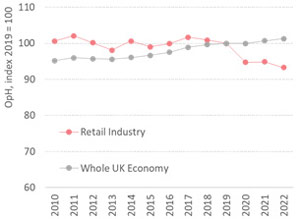 Chart 2: Retail Productivity
Unit of real output per hour (OpH), chained volume measure.
Source: Office for National Statistics.
To simplify our point here, let’s assume for a moment that all employment costs are given (exogenous) to any retail business (price taker), then, the key driver to minimise unit labour cost (ULCs) is productivity, defined as the output per hour worked (e.g., number of dispenses completed by a sales assistant). So far, the retail industry has detracted sensibly from productivity growth over the last years, not only dropping sharply after the pandemic outbreak but also performing clearly below the average of the whole UK economy (see chart 2).
This is when labour planning comes on stage, as it can directly influence retail productivity. It’s worth mentioning that staff optimisation is not about reducing staff per se but having the right number of colleagues at the right time in the right place, which is much more complex and denotes several challenges and questions to respond to. Is it possible to forecast the exact number of customers that will visit our store in a particular day and hour? What is the ideal workforce to reach sales potential? What is the right mix between part-time and full-time workers? Which labour regulations or practical constraints affect our ideal planning? What is the impact of omnichannel on store labour?
Unfortunately, we won’t be able to find all the answers in this article, however the spirit of labour planning can be summarised in three major steps. First, we set store potential essentially as a function of labour and customer traffic (other things being equal). We should be aware of the “dual” effect of labour on store profit at this point. From a top line perspective, staff availability will improve sales in line with the queuing theory, which states that the more sales assistants the fewer customers will leave the store without being served. On the other hand, from a bottom-line view, labour is one of the most important costs in the retail structure. Hence, we have to find the right balance between labour availability and costs, adding labour as long as their contribution to store sales (output) exceeds their incremental in cost.
Chart 2: Retail Productivity
Unit of real output per hour (OpH), chained volume measure.
Source: Office for National Statistics.
To simplify our point here, let’s assume for a moment that all employment costs are given (exogenous) to any retail business (price taker), then, the key driver to minimise unit labour cost (ULCs) is productivity, defined as the output per hour worked (e.g., number of dispenses completed by a sales assistant). So far, the retail industry has detracted sensibly from productivity growth over the last years, not only dropping sharply after the pandemic outbreak but also performing clearly below the average of the whole UK economy (see chart 2).
This is when labour planning comes on stage, as it can directly influence retail productivity. It’s worth mentioning that staff optimisation is not about reducing staff per se but having the right number of colleagues at the right time in the right place, which is much more complex and denotes several challenges and questions to respond to. Is it possible to forecast the exact number of customers that will visit our store in a particular day and hour? What is the ideal workforce to reach sales potential? What is the right mix between part-time and full-time workers? Which labour regulations or practical constraints affect our ideal planning? What is the impact of omnichannel on store labour?
Unfortunately, we won’t be able to find all the answers in this article, however the spirit of labour planning can be summarised in three major steps. First, we set store potential essentially as a function of labour and customer traffic (other things being equal). We should be aware of the “dual” effect of labour on store profit at this point. From a top line perspective, staff availability will improve sales in line with the queuing theory, which states that the more sales assistants the fewer customers will leave the store without being served. On the other hand, from a bottom-line view, labour is one of the most important costs in the retail structure. Hence, we have to find the right balance between labour availability and costs, adding labour as long as their contribution to store sales (output) exceeds their incremental in cost.
It’s worth mentioning that staff optimisation is not about reducing staff per se but having the right number of colleagues at the right time in the right place
The articles from these contributors are based on their personal expertise and viewpoints, and do not necessarily reflect the opinions of their employers or affiliated organizations.
